
Suitcase and luggage retailer, UK
Building a paid search channel from a standing start
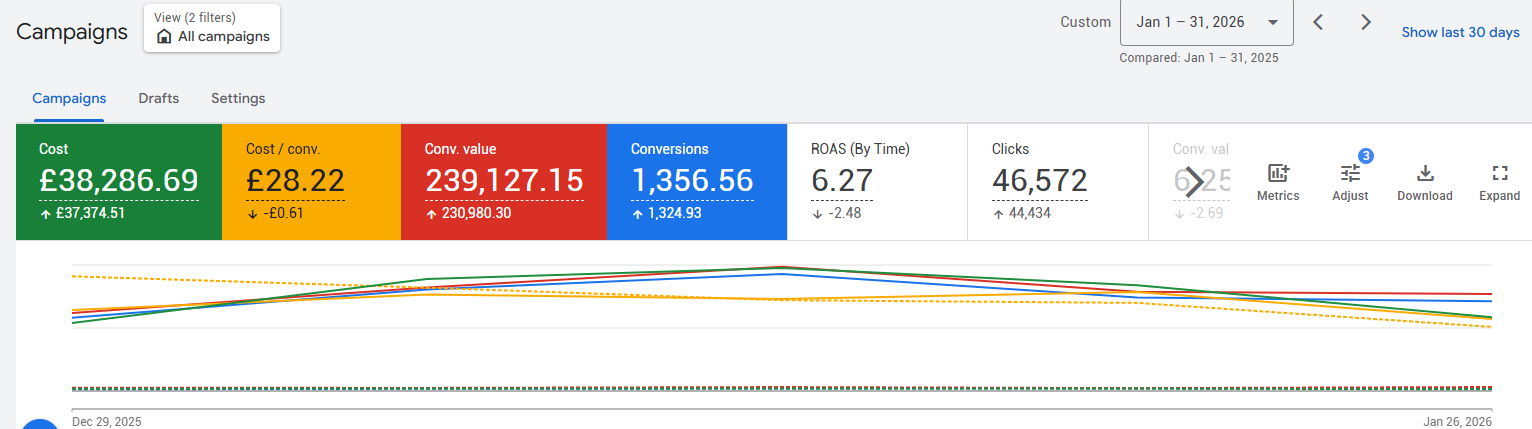
January 2026 against January 2025. Ad spend up from £912 to £38,287, with return on ad spend held at 6.27 against a 5.0 minimum.
The situation
This client is a major UK luggage and suitcase retailer. They were doing well, but paid search was not really part of how they sold. They had an account, they were spending under a thousand pounds a month on it, and their honest position was that they did not understand it well enough to commit properly.
The luggage market is brutal. You are up against the big brand sites, the marketplaces and the department stores, all bidding on the same terms with far bigger budgets. Getting into that and staying profitable is not straightforward.
Before any spend went up, we worked out their actual profitability and their MER. That gave us a hard floor: return on ad spend could not drop below 5.0. Below that, scaling would be growing revenue while losing money, which is a very easy trap to fall into in a market like this one. The brief was to build a real paid search channel, competitive enough to matter, without ever breaking that floor.
What I did
Four decisions, in this order
Established the floor first, then built to it
The 5.0 minimum came out of their margins, not out of a benchmark or a guess. Every decision after that was measured against it.
Built the account properly rather than scaling the old one
Structure, targeting, feed and tracking all had to be right before serious money went through it. An account spending under a grand a month can carry a lot of inefficiency without anyone noticing. The same inefficiency at forty times the spend is expensive.
Went after the traffic that converts, not the traffic that looks good
In a competitive market it is very easy to buy a lot of cheap clicks that never turn into anything. The work was in identifying which searches actually led to sales and putting the budget there, rather than spreading it across everything that mentioned luggage.
Scaled in steps, watching the floor
Spend did not go from under a thousand to thirty eight thousand overnight. It went up in stages, and each increase was held only if the return stayed above the line.
The results
January 2026 against January 2025
Those last two are the ones I would point at. Normally when you scale spend this hard, efficiency drops. You exhaust the easy demand and start paying more for worse traffic. Here the opposite happened. The account is spending forty two times more money, and every pound of it is working slightly harder than it was before.
About that ROAS figure
If you look at the screenshot you will see ROAS marked as down 2.48, from 8.75 to 6.27, and I would rather explain that than leave it sitting there.
The 8.75 was achieved on £912 of spend. At that level you are only picking up the people already searching for the brand, the ones who were going to buy anyway. Of course the return looks incredible. It is not a number you can do anything with, because it does not scale. The moment you try to grow it, it collapses.
Delivering 6.27 across £38,287 is a completely different achievement, and it is worth roughly £231,000 more to the business. A high return on a tiny budget is not a channel. It is a rounding error with good optics.
About that total revenue figure
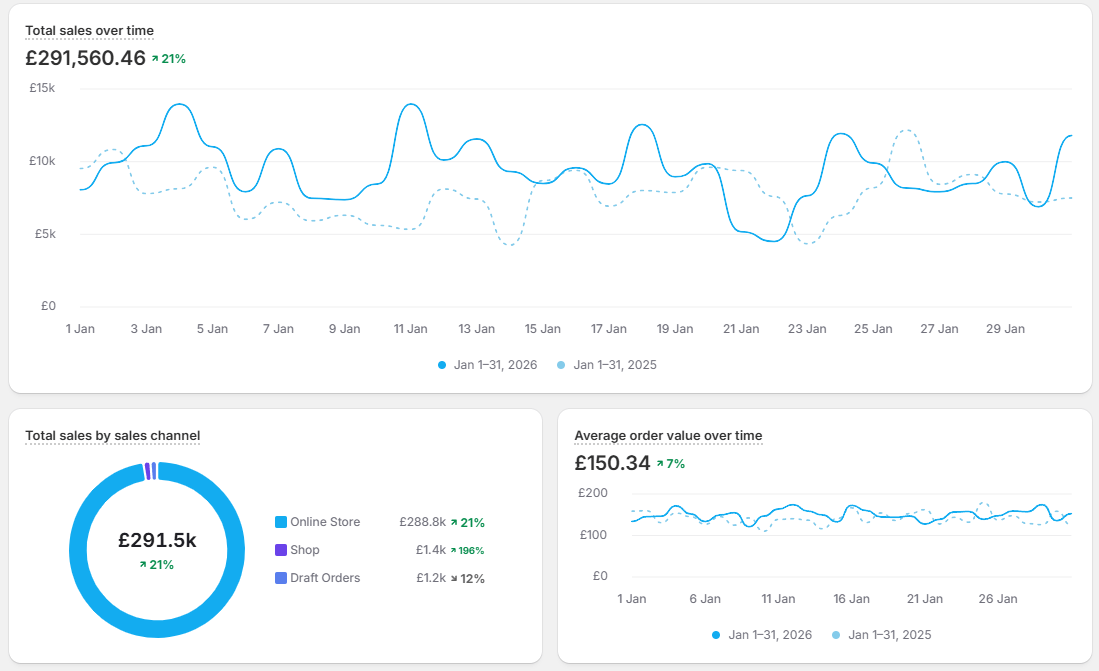
Total store revenue for the same month was up 21% year on year at £291,560, with average order value up 7%.
Compare that to the ads figure and you will notice something. Total business revenue grew by around £50,600 while ad spend grew by £37,374. Google is reporting £239,127 in conversion value, but the whole business did not grow by anywhere near that.
That is normal, and it is worth understanding. Some of the revenue attributed to paid search would have arrived anyway through organic, direct or brand searches, and this client is heavily weighted towards paid, so there is a lot of overlap. Platform attribution always overstates its own contribution. Anyone who tells you otherwise is either not looking or hoping you are not.
The number that matters is the blended one. £291,560 of revenue on £38,287 of ad spend is a MER of 7.6, which is a genuinely healthy business. And because this client leans so heavily on paid, keeping that blended figure honest matters more here than it would elsewhere. If paid search is doing most of the selling, you cannot afford to be wrong about how well it is working.
The takeaway
If you have been holding off on paid search because you do not fully understand it, the answer is not to spend a little bit and see what happens. Small spend gives you flattering numbers that tell you nothing.
Work out what your margins can actually sustain, set a floor, then build to it properly. That way you know before you start what success looks like, and you know the moment it stops working.
This one started with an audit too
What could your account do?
I go through the account, tell you honestly what is working and what is not, and you keep the report either way. If we have not worked together before, that first audit and conversation is completely free.